Eish! Inspired by the sheer physicality we’ve witnessed in the current Rugby World Cup and the awe-striking efforts of the 2023 Tour de France, I decided to whip up a lekker piece about exercise zones, sprinkled with a hearty dose of braai talk.
I’ve been hunting high and low for a consolidated exercise zone tracker to hang in the garage next to my exercise paraphernalia, World Cup tracker and braai recipes. But, finding the perfect one was like searching for a needle in a haystack. So, in true South African spirit, I decided to just gooi it and create my own to share. We’ll tackle it in phases, just like we tackle a boerewors roll.
In this post we’ll cover:
5 zone training Pyramid
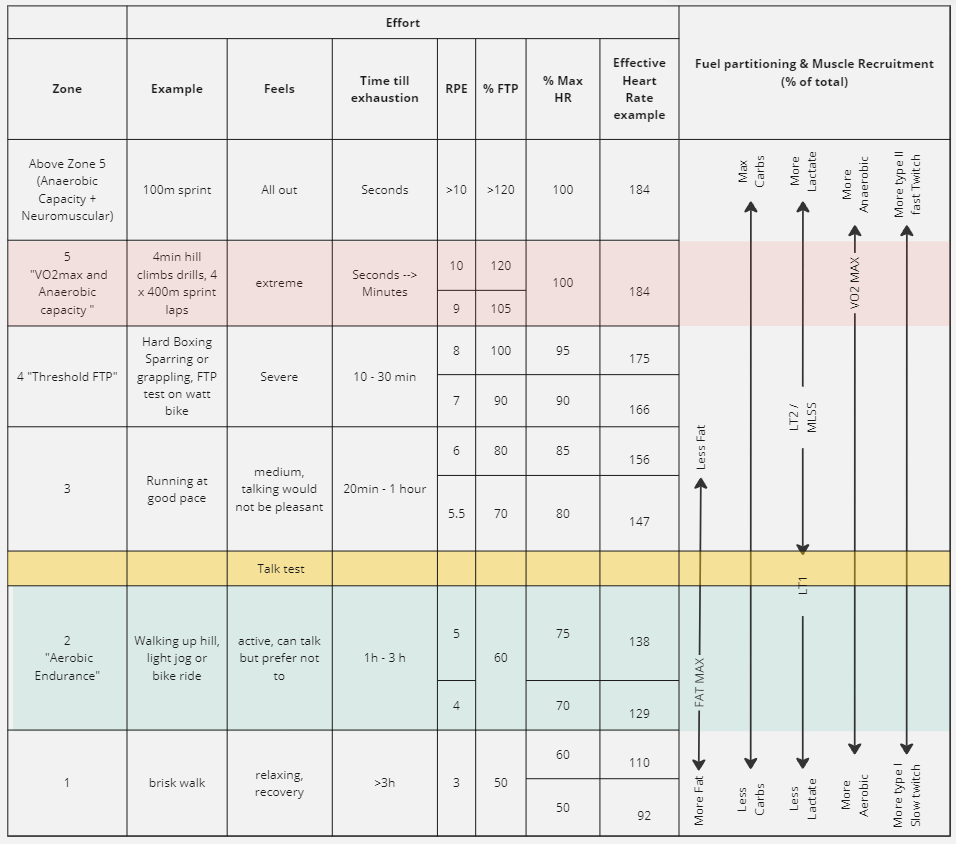
Definition of the 5 Zones by effort and fuel partitioning
Zone 1
Zone 1 Effort: Picture this – you’re briskly walking through the V&A Waterfront, taking in the sights and sounds. It’s lekker and relaxing, that’s Zone 1 for you. Activities here, like walking, score a 3 on the perceived exertion scale. If you were sporting a heart rate monitor, like a fancy tech guru, it would probably be clocking around 50% of your max heart rate. For my scientific buddies out there, think about 50% of your functional threshold power (FTP). To put things into perspective, if you have a max HR of 184 bpm, the next column will give you the juicy numbers for each zone.
Zone 1: Fueling the Braai, Biochem-Style:
This zone is like a long, slow braai – the energy comes mainly from the oxidation of fat (β-oxidation), and carbs are just the side salad here. Considering that fat is the main player on the field, it’s the go-to for our bodies during such activities. Plus, our bodies primarily use the slow-twitch Type 1 muscle fibers in this zone, packed with mitochondria and myoglobin, giving them that rich boerewors color.
Zone 2
Zone 2 Effort: As you shift into Zone 2, it feels like you’re trudging up Table Mountain without the cable car. It’s that struggle of maintaining a steady conversation while you’re panting away. If you can chat away without gasping, you’re probably still chilling in Zone 1. But, if you sound like you’ve just run the Comrades Marathon, you’ve probably hit Zone 3. Technically speaking, you’re looking at an RPE of about 4-5, 60% FTP, and around 70–75% of your HRmax (like 129 – 138bpm).
Zone 2: The Fat Jol and The Sugar Rush:
Zone 2 is the fat party (or fatmax) where your body’s burning the highest amount of fat calories per minute. Beyond this intensity, the body’s reliance on carbohydrates as a fuel source starts to dominate, and fat oxidation decreases. But, don’t be fooled, carbohydrates are gatecrashing this party meaning our body needs to deal with the uninvited guest, lactate. However, the body can still keep the vibe gesellig as MCT 1 and MCT 4 transporters deal with lactate (More on this later)
But as we push the tempo and head into zone 3, things start to change. Our body, shifts its energy sources. It’s a bit like switching from rooibos to a strong espresso. Got a lekker question ticking in your brain? Like, why pick chips (carbs) when there’s a feast of fat (skilpadjies) on offer?
Why switch from fat with so much of it available?
- Fat metabolism is aerobic and relies on oxygen. It’s like a slow jam at a Sokkie. But, when the beats drop, and the intensity hits the roof, the muscles switch to the club-banging anaerobic glycolysis pathway.
- Is it the CPT enzyme acting all diva? It’s a possibility. CPT I helps ferry those fatty acids into the mitochondria party. But when it gets overwhelmed, it might just step out, making us rely more on carbs.
- It’s not just about the muscle fibres. It’s a jive between Type I (slow-twitch) and Type II (fast-twitch). As the party intensifies and the slow-twitch fibers cant keep up, the fast-twitch fibers step up to the dance floor.
- Alright, my curious comrades, in a future jam session, we’re diving deep into the rhythmic beats of beta-oxidation and those cheeky rate-limiting steps. See the lekker pic below right now to get those brain wheels turning. Until then, get those hypotheses ready
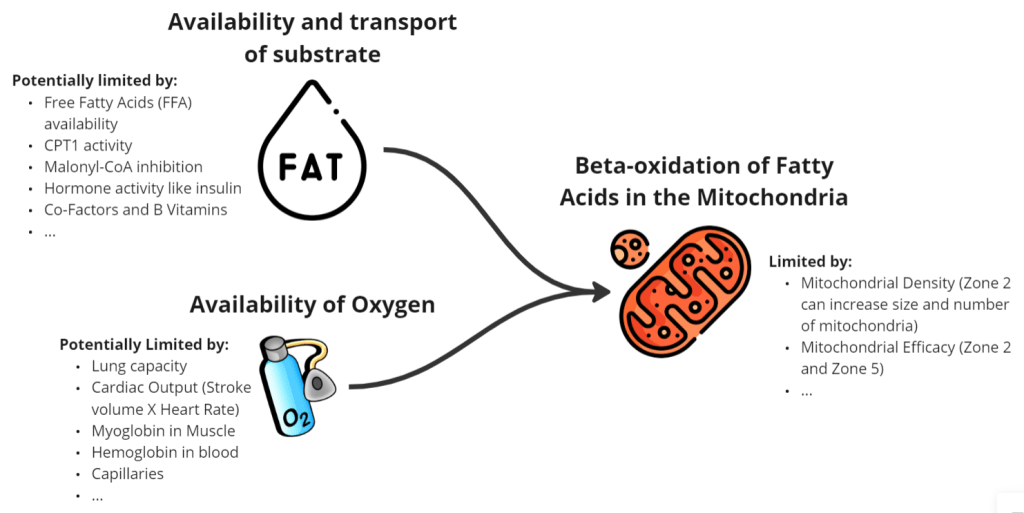
Let’s Turn Up the Heat with Zone 3
Eish, as we shimmy from Zone 2 to Zone 3, imagine crossing that orange line on our groovy table. That line? That’s the aerobic threshold, or as the boffins call it, lactate transition point 1 (LT1). Although common lactate figures of 2mmol/L is thrown around the braai, this is dependent on the conditioning and physiology of the individual.

You’ll be pumping out more cortisol – that stress hormone – and you’ll notice it in your heart rate and your morning-after recoveries. It’s the line in the sand between a chilled jog and an all-out sprint on Camps Bay beach.
You see, LT1 is where your body starts chucking more lactate into the bloodstream but still manages to juggle it. We’re still mainly on fat fuel, but things are heating up. And while many charts try to pinpoint this threshold with a magic number, it’s more like the Cape Doctor – sometimes strong, sometimes gentle. Everyone feels it differently.
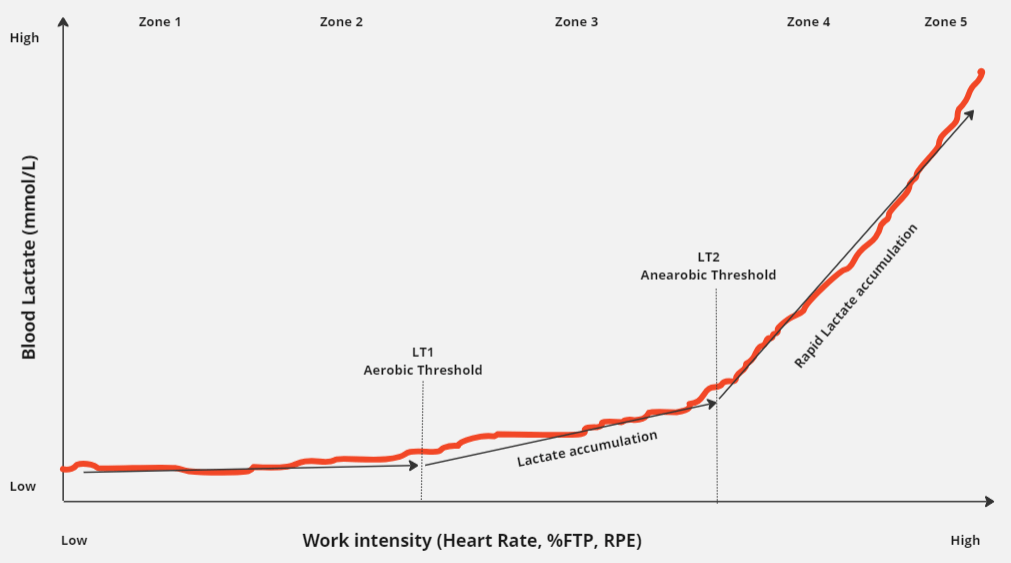
Now, when you’re vibing in Zone 3, picture running or cycling like you’re late for the Boks game. You’re pushing hard, feeling that burn, but you can still shout at the ref for a dodgy call. This zone, in tech talk, is about 70-80% FTP and about 80% HRmax.
The Fuel Shuffle in Zone 3:
Remember how I mentioned the fuel change-up? Zone 3 is where your body starts opting for carbs over fats, just like we might pick a quick BP pie over a slow-cooked potjie when we’re really hungry. Most folks spend heaps of their training time here, and well address potential shortcomings of this approach in a future post.
Zone 4: The Grueling Grind
Ever tried a full-out 20-minute watt bike challenge? Or going toe-to-toe in a boxing match? That’s Zone 4 for you. It’s the “give it all you got” zone, where you’re 90-100% FTP and 90-95% HRmax. The key thing here is the second lactate shift, where your body’s just drowning in the stuff. It’s the point where you’re pushing so hard you’re about to hit the red.
Zone 4 Fuel Feels:
This is where your body’s chowing down on carbs like it’s going out of fashion, and the lactate’s pouring like it’s happy hour. But, the silver lining? Training here can make you a lactate-clearing machine.
Zone 5: The Mzansi Madness
Entering Zone 5? You’re sprinting for that last piece of boerewors. Think explosive, like 4-minute sprints or 400m dashes. Numbers? Chuck ’em, you’re just going flat out.
Zone 5 Fuel Frenzy:
In this adrenaline zone, where VO2 max vibes reign supreme, it’s a carb-fest. This isn’t just any intensity; we’re talking about the peak of your oxygen game. You’re relying majorly on those fast-twitch fibers, and with the air you’re sucking in, you’d think it’s a sneaky vuvuzela concert. Some boffins reckon this zone, with its VO2 max magic, is the golden ticket to powerhouse mitochondria. But, as with anything Mzansi, opinions are hotter than a peri-peri chicken wing. Any activity past this zone is supercharging that glycolytic energy system. The result? A lactate bonanza.
A note on lactate clearance Trade-offs
Imagine the club, Muscle Groove, bustling with dancers, okes and patrons (lactate). At the entrance, you’ve got Monocarboxylate transporter 1 (MCT1), the suave bouncer who checks IDs, ensuring all the lekker okes get in. He’s the chap making sure the club vibe is on point, vibing to the Zone 2 beats. But a party ain’t a party without some drama, right? For those troublemakers and unruly patrons, you’ve got MCT4, the muscle-bound bouncer at the exit. He’s the one tossing the swak okes onto the street, making sure they don’t spoil the fun inside.
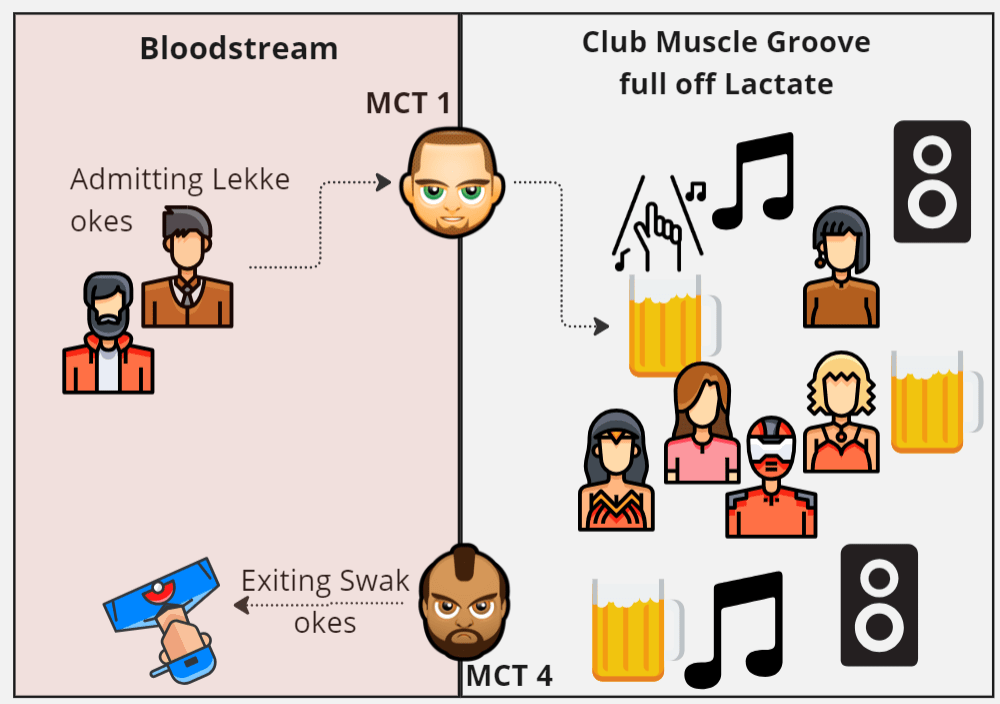
Now, if you want MCT4 to offload those troublemakers faster, you’ve got to make sure the club is pumping! The more crowded and intense the party, the more practice he gets. That’s where Zone 5 training comes in, turning up the heat, filling the club with more dancers, and ensuring MCT4 gets that workout.
But while you’re at it, don’t forget about MCT1. To keep the club’s vibe lekker, you want him smoothly checking IDs, letting in the good vibes. And that’s where Zone 2 training shines, ensuring MCT1’s ID checks are sharp and efficient.
So, train in Zone 2, and you’ll have MCT1 making sure the club vibe is top-notch. Pump it up to Zone 5, and MCT4 will be working double-time, keeping the riff-raff out. It’s all about balance, boet. After all, you want the club, Muscle Groove, to be the talk of the town!
That’s it for now, I hope you enjoy the Zone 5 pyramid and reading some biochemistry with a South African twist. In a followup post ill talk about common misconceptions on how endurance athletes train. And trust me, you’d be surprised to find how much time they’re chilling in zone 2, much like Uncle Kobus at a braai, taking his sweet time to get that potjie perfect. In the interim, for those of you itching to dive deeper into these zones and the lekker magic happening within, pull in to the works of some true legends: Dr. Iñigo San Millán and Dr. Stephen Seiler.
 Joshua Wallace
Leave a comment