This post is the first of a series of biochemistry related topics that crop up often during weekend braais. Typical questions include, how long should I spend on the bike, what is best for my endurance, what zone do you train in, do you even lift, bro? Inevitably these conversations end up doing a trip down biochemistry lane, but it is entirely likely that I am also finding ways to retrofit biochemistry into all conversations. However, if you allow this concession to slide, I do believe that some basic principles of biochemistry and human energy systems will create a foundation to help answer some of the questions above in future posts.
Considering most South Africans are facultative electricity experts by national decree, and most office workers moonlight as part time electricians to wire their inverters and backup battery systems, I believe I have just the analogy to describe the basics of the human energy system. Here we go…
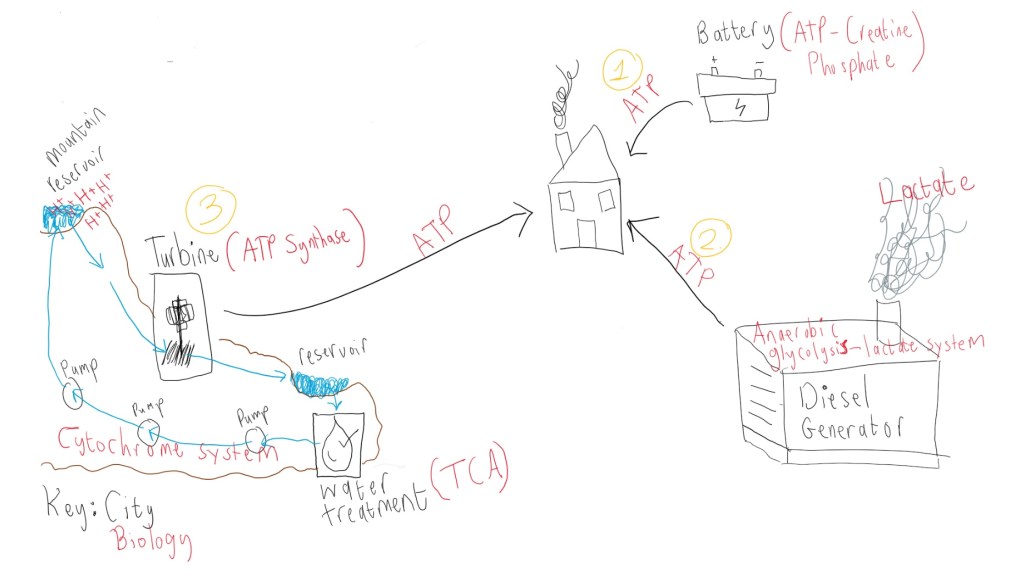
Picture the City of Cape Town, with its diverse energy demands from businesses, homes, industries, and so forth, symbolizing the varied energy needs of the human body during daily activities. In the city, the energy is manifested as electricity. In the body, this energy is represented by Adenosine Triphosphate (ATP). To meet all its energy requirements, the city relies on three primary systems:
- Backup Battery in your home (ATP-Creatine Phosphate System) ideal for short sudden demands of energy
- Diesel generator (Anaerobic respiration / Glycolysis / Lactate system) which produce energy during times of high demand but comes at a cost, that beautiful humming sound heard all over the country. This system provides a bridge between the depleted batteries and the more sustainable long-term energy in system 2 in periods of high demand, like the glycolysis (lactate) system.
- A hydroelectric pumped water scheme (Aerobic Respiration) that provides a steady supply of energy for daily activities like the efficiency of like aerobic respiration in our cells during steady state demand.
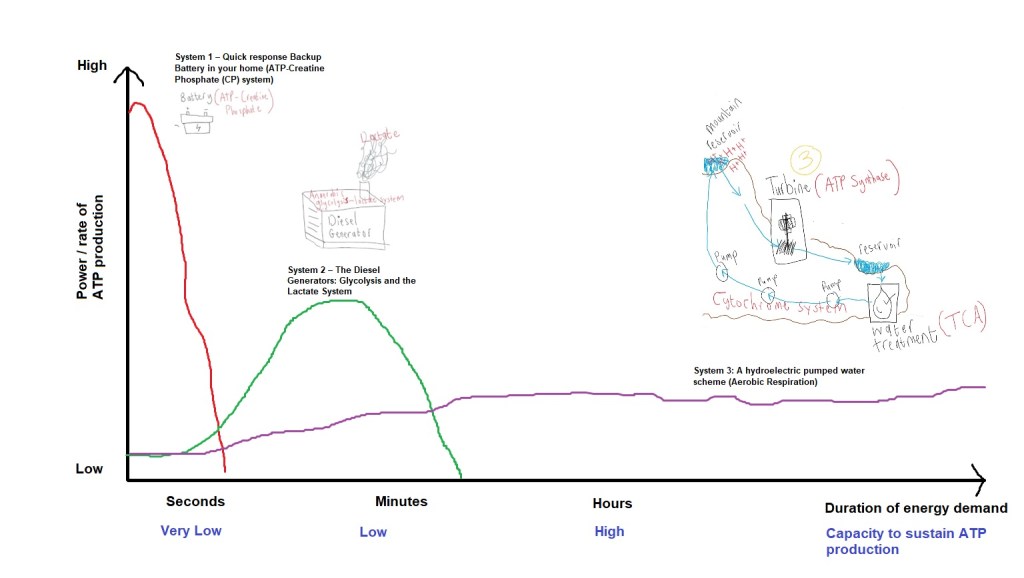
System 1 – Quick response Backup Battery in your home (ATP-Creatine Phosphate (CP) system)
When there’s an immediate need for energy (like suddenly turning on many appliances), the backup battery in your garage, school or work environment is perfect. However, these systems often cannot power multiple appliances or multiple households for extended periods of time. Similarly, when you need to quickly sprint for 15 seconds of glory while you race your friend on the beach or when you say, “hold this beer” and attempt to lift a heavy couch to impress the mates, it is the ATP-Creatine Phosphate (CP) system that comes to the rescue. The ATP – CP system acts as an immediate source of energy for short, rapid bursts of activity, lasting about 10 – 30 seconds. This happens as CP donates its phosphate to Adenosine diphosphate (ADP), rapidly producing ATP in the chemical reaction ADP + CP → ATP + Creatine. This reaction does not require oxygen (anaerobic).
System 2 – The Diesel Generators: Glycolysis and the Lactate System
When the city struggles to meet high demands, generators that can burn gas or diesel are brought online. These generators can ramp up quickly and address energy needs, allowing the city to function. However, these generators are noisy, produce various waste products, and are quite expensive to run for extended periods. Power generated by System 2 can be consumed immediately during the city’s peak demands or be used to help pump water up a mountain when energy needs are steadier (system 3).
In the body, the Anaerobic (without oxygen) glycolysis-lactate system kicks in once the initial burst of energy from system 1 (ATP-CP) is depleted. System 2 continues to produce 2 ATPs for every glucose molecule it breaks down to pyruvate. During peak energy demands, when our muscle cells lack oxygen, this pyruvate is converted to lactate. Analogous to diesel generators that can ramp up swiftly but with significant costs, the Glycolysis and Lactate System works faster than system 3 (Aerobic Respiration) but is 16 times less effective at ATP production per molecule of available glucose (System 3 produces 32 ATPs per glucose molecule, compared to the 2 ATPs of system 2). This method of producing energy without oxygen is prevalent in simple organisms that evolved when Earth’s oxygen concentration was low.
Although I have depicted lactate as diesel exhaust fumes, suggesting it’s a waste product, the understanding of energy metabolism has evolved and lactate is no longer seen as mere waste. Research by Iñigo San Millán—who also happens to be the coach of cycling phenom Tadej Pogačar—and Joshua D Rabinowitz has highlighted the role of lactate as a fuel. It makes sense, as lactate is a three-carbon carbohydrate (essentially half a glucose molecule). It’d indeed be wasteful not to harness this energy source. (But hey, that’s a topic for another day!)
System 3: A hydroelectric pumped water scheme (Aerobic Respiration)
Now, imagine if the Steenbras pump scheme could supply the majority of Cape Town’s energy needs during times of steady, long-term, sustainable demand. Sure, I’m aware that in reality, Steenbras functions more as a peak demand system than a base load system. But, hey, the very first word in the sentence asks you to “imagine,” so let’s not get bogged down in technicalities. This serves as a metaphor for our aerobic respiration system.
Picture two reservoirs: one perched atop mountains and the other at sea level. Connected to the bottom reservoir is a water purification plant (representing the tricarboxylic acid cycle (TCA)/Krebs cycle/citric acid cycle) ensuring excellent water quality before it is pumped back to the reservoir above. Similarly, in our cells, the TCA takes products like pyruvate, processes them by releasing carbon dioxide and high-energy electrons, which then feed into the cytochrome system, the pumps and pipes of our scheme.
Connecting these reservoirs is an intricate system of pumps and pipes (representing the cytochrome system) and a sizable hydroelectric turbine (symbolizing ATP Synthase). Just as those pumps work tirelessly to transport water back to the reservoir at the mountain’s summit, the cytochrome system diligently pumps protons from the mitochondrial matrix to the intermembrane space, establishing a proton gradient (symbolized by H+ ions). This gradient is akin to having a fully stocked reservoir at the mountaintop.
For electricity generation, the potential energy stored in the upper reservoir’s water flows through the turbine. Similarly, in our bodies, protons (bearing electrochemical energy) navigate down their concentration gradient through ATP synthase which transforms the electrochemical energy, harnessed from the proton gradient, into mechanical energy (subunit rotation), and back into chemical energy in the shape of ATP. This biological turbine produces bucket loads of energy (ATP) just like the electricity produced by the turbine in the hydroelectric pump scheme.
We can also draw a parallel between the power demand versus duration of the city and that of the human as follows:
Thanks to the bunch of Biochemists and Sport Scientists at Sapio for almost giving my analogy a passing mark and critiquing my drawings, what doesn’t kill you makes you stronger!
 Joshua Wallace
Leave a comment